

The Heart Styles Model. A Practical Explanation
The Heart Styles model is a character and culture compass, not a personality test.
It focuses on how people show up under pressure, and why capable individuals and teams often behave in ways that quietly limit performance, trust, and growth.
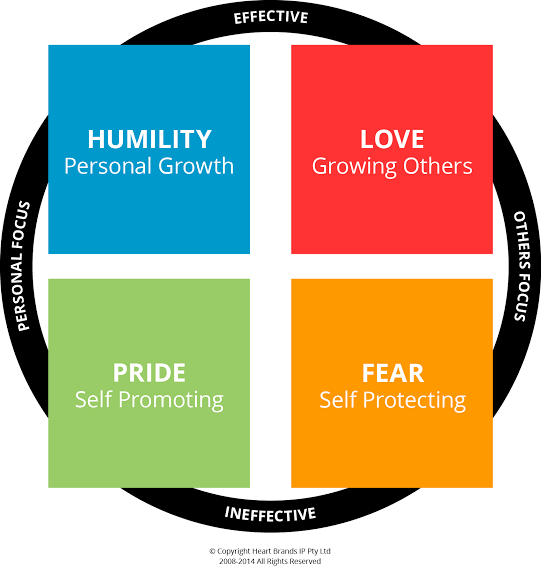
At its core, the model maps behaviour across two dimensions:
1. Effectiveness vs. Ineffectiveness
The upper half of the compass represents effective ways of being. These are associated with higher performance, healthier relationships, stronger well-being, and sustainable growth.
The lower half represents ineffective patterns. These are not flaws. They are normal human defence responses that emerge when people feel threatened, unsafe, or undervalued.
Crucially, people move between these states constantly. Sometimes within minutes. Context and triggers matter.
2. Internal Focus vs. External Focus
One axis reflects where attention is placed.
● An internal focus is about how someone experiences themselves. Their values, integrity, and inner alignment.
● An external focus is about how someone believes others experience them. Approval, perception, status, or rejection.
Over-reliance on the external focus often pulls people away from authenticity, even when intentions are good.
The Four Heart Styles Quadrants
Blue. Courage and Humility (Effective, Internal)
This is the foundation of personal growth.
Here, people:
● Acknowledge strengths and blind spots
● Stay open to feedback without collapsing or defending
● Act from values rather than fear of judgment
● Show up authentically, even when it feels uncomfortable
Humility here is not self-deprecation. It is honest self-respect combined with openness to growth.
Courage is required to hold both.
Red. Love and Respect (Effective, External)
This quadrant focuses on creating environments where others can grow.
It includes:
● Compassion and empathy
● Belief in others’ potential
● Coaching rather than controlling
● Holding high standards without domination
This is not indulgence. It is respectful, growth-oriented leadership that energises both the giver and the receiver.
Orange. Social Fear and Self-Protection (Ineffective, External)
This activates when the need to belong feels threatened.
Common behaviours include:
● Seeking approval
● Avoiding conflict
● Becoming dependent
● Withdrawing to preserve harmony
These patterns protect against rejection, but they limit expression, agency, and contribution.
Green. Ego and Over-Control (Ineffective, Internal)
This emerges from a deep sense of “not being enough”.
It can show up as:
● Excessive control or dominance
● Needing to be right or superior
● Over-asserting expertise
● Competing rather than collaborating
Although it looks powerful, it often distances people from the connection and respect they actually want.
Ineffective behaviours are defence responses, not character flaws.
Judging them strengthens them.
Compassion creates the conditions for movement.
Fear is softened by courage.
Ego is softened by love.
This is why the model is described as creating the soil.
It shapes the internal and relational environment in which clarity, strategy, and performance can actually take root.
Without this soil, even the best ideas struggle to grow.